The transport of insects must be secure, to fit the facility’s production flow, and include recognizing both the transported items as well as the locations and the routes, in addition to be able to cope with either humans or other robot activities. Various types of crates are used to keep apart and transport different insect instars. Production is done in maximum density requiring fine control of the crate pick up, delivery and transport. The main goal is to make crates available for processing and deliver them for incubation and storage.
Large-scale trials in 5 European insect farms
Nasekomo, Entomotech, Entocycle, Italian Cricket Farm, Invertapro
CoRoSect aims at fulfiling real operational needs
By targeting the delivery, deployment, demonstration and thorough evaluation of a functional system prototype in real-world operational environments
To demonstrate the scalability of the proposed system, 3 specific types of insects will be used
Black Soldier Fly Hermetia illucens
Black Soldier Fly farming is presently the most widespread form of insect farming in the world. The Black Soldier Fly is ideally suited for food production due to its rapid production cycle and high concentration of protein. The high percentage of protein in the larvae makes them an ideal source of food for a wide variety of animals.
MealwormTenebrio molitor
Mealworms are grub-like larvae of darkling beetles that are a protein-filled feed perfect for chickens as well as feed for other domestic birds, reptiles, and fish. Mealworms are also edible for humans, and processed into several insect food items available in food retail such as insect burgers.The small amount of space required to raise mealworms is what makes them a popular choice for insect farmers.
CricketsAcheta Domesticus
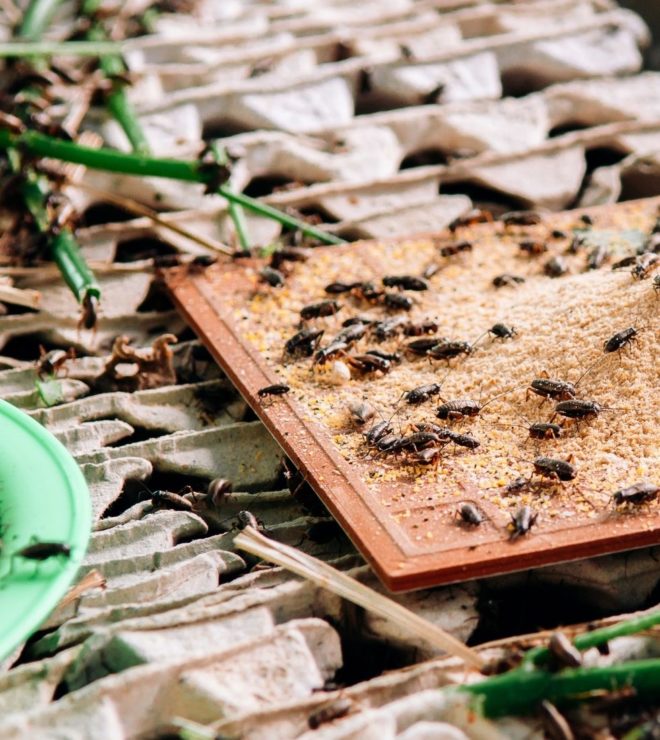
Crickets are generally raised for their meat, just as poultry or cattle and they are an excellent source of nutrients for humans. They are an immensely rich source of protein, as well as fibers, vitamins, minerals, and ALL of the essential amino acids. Additionally, crickets are also more easily digested than other traditional sources of protein, like whey or beef.
Insect farming stories you won’t find anywhere else
Team up for further success
Robotnik and ATOS have create D-Robot that can robustly and accurately destack and stack crates filled with insects, WITHOUT crashing them. They have achieved this by using the 3D simulator (Gazebo), interface for the robot (ROS), and open source tool for planning the robots’ trajectory paths (Movelt) within the modelled environment. Furthermore, a server (OPC-UA server) was developed for updating the status of the D-Robot’s movements, execution of commands and determination whether the actions have succeeded or failed. Moreover, the server connects to the CoRoSect Informatino Management System (IMS), and serves as a bridge between the IMS and ROS.